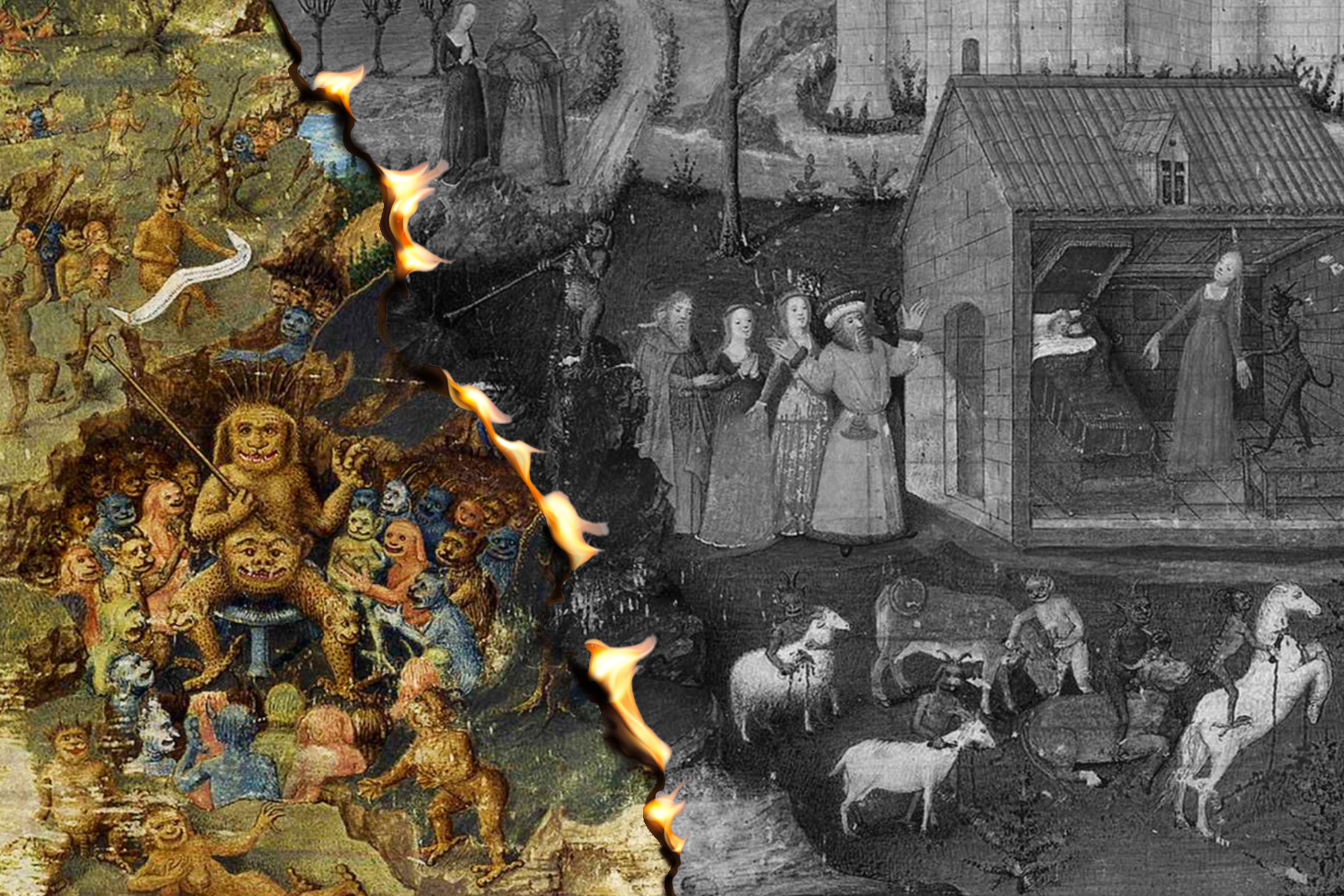
When I finally got an iPod in college, my first instinct was to lovingly wrap it in a skin of Hieronymus Bosch’s Garden of Earthly Delights. In that moment, I believe I was fated to one day read and adore Between Two Fires.
As I was reading, I kept trying to describe it to others: “It’s kind of like being dropped into the busy margins of an illuminated manuscript. The ones where bunnies are lopping off people’s heads with swords and bathers are being prodded by cat-faced demons.” I want more than anything to go off on tangents about the demonic bestiary contained within this book, but its monsters are such treasures that I’d feel like I was spoiling things.
So instead, I’ll focus on the craft.
Since early last year I’ve been bingeing horror books of all kinds to try and learn more about how they tick. I’ve read a lot of mediocre books, and a handful of good ones. But even the classics like Frankenstein (which I loved) didn’t push my personal suspense buttons the way I hoped they might. Algernon Blackwood’s The Willows came the closest at its apex, and Carrier Wave by Robert Brockway had its moments, but I still felt like I was searching for something — something I would love so much on a personal level that I would be compelled to dissect it.
Enter Between Two Fires by Christopher Buehlman.
Buehlman’s keen understanding of point-of-view allows him to adopt a multitude of different character perspectives and to flow between them without confusion. Importantly though, he doesn’t shift perspectives without a purpose.
Much of the book’s second act can be divided into frightening vignettes, each centering around their own supernatural encounter. Often, as an introduction to these vignettes, the author introduces a new character. Within just a few paragraphs he’s able to paint them vividly enough so we never forget their names. This is often a character who witnesses a monster before our heroes do, or who has at least had brushes with something amiss in their town. In one creative case, this character is an animal.
This way of introducing new dangers results in an almost cinematic style. And these scenes, with their instant character investment, stand in for exposition. They plant dread in the reader before any of our heroes arrive on-scene. It means nothing has to be explained by the time all hell breaks loose. It’s masterful.
But the POV mastery extends beyond that. As a writer of romance, a genre that often features dual perspectives, I struggle in the lead-up to poignant moments to choose whose POV will be more interesting. I often choose the sophomoric approach of staying in the head of the “reacting” character. While I already recognized that this approach is kid-stuff, one of Buehlman’s most delicate POV choices made me want to tear up my manuscript and call my mom to pick me up from kindergarten.
Again, I won’t spoil it, but there’s a moment in the book where Buelhman has carefully laid out the emotional stakes for a certain character, and I fully expected to be in their head for any “payoff.” I expected a gushing internal catharsis that went on for pages. Instead, we experience their reaction through one quick line of thought from the person they’re reacting to — a person who is completely naive to why they’d be reacting at all. That one little sentence shattered me.
Why? Because Buehlman trusted he’d set up the stakes properly, that readers would be able to place themselves in that character’s position and understand. There exist, sometimes, emotions of such depth that words really do fail. Instead of flailing around trying to explain the unexplainable, Buehlman steps back and acknowledges that there are no words. He lets us sit in it and fill in the blanks, not with words, but with our own gut feelings.
I kid, of course, about how upset I am to witness such skill. I feel so far out of my depth when I read something like this, something that pleases me so utterly, but that doesn’t mean I’m not also inspired. I’m still luxuriating in the afterglow of this read, but I’ll be going back to study. To study why I was scared when I was scared, and why I was hurting when I was hurting. To study how I felt such intimacy with the characters within one page of their introductions.
I took my time with this book. The pacing is breakneck at times, one night keeping me up until 3am reading by candlelight during a power outage. But whenever there was a breather, I’d set it down for a week or more, waiting for the perfect mood to strike. I finished it on a rainy day.